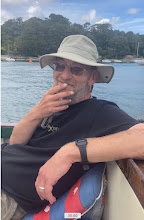
The first blog by a British prisoner. Variously described as being "obviously extremely intelligent" (Michael Gove), "the most interesting interview I have ever done" (Michael Portillo), and a "fully paid up member of the awkward squad" (Parole Board), I try to generate debate around the moral and political nexus that is imprisonment. Imprisoned between ages 14 to 47, released on Licence in August 2012
Aeons ago, just after my Zen Tukai Jokudo ordination, I was having a fierce argument in a corridor with a
governor about whether I could wear my token kesa. This is a token robe, essentially a two inch strip of
black cloth worn hanging from the neck. The Gov wasn't having any of it, even if I wore it beneath my
clothes.
"It will make you stand out!", and he wasn't having such flamboyance perturb his uniformity. As he spoke, a Sikh walked past, sporting the most fluorescent yellow turban in the land. The governor and I stared at each other in the unspoken common knowledge that we had both seen this apparition and it made utter nonsense of the Gov's declaration.
I'll give him his due. He didn't bat an eyelid. Or retreat a single inch. It is this level of shamelessness in the face of reality that is the hallmark of the modern prison manager.
I can chart fundamental changes in my life to a handful of books. They affected me at particular moments of my life and altered the way I saw myself, my place in the world, and the potential that I contain for internal and external change.
There was a short time, early in my sentence, when I mistakenly decided that as my crime resulted from an outburst of emotion, then emotions must be "bad". As a result I began making deliberate efforts to suppress my emotions, expending huge efforts of will running around inside my own head to squash them as soon as they appeared. And this was a path destined to lead to either insanity or real, long term dangerousness.
Someone threw me a book, 'Zen Flesh, Zen Bones'. It contained brief explanations of Zen Buddhism, koans and parables. Even as a callow teen, it suggested to me that suppressingemotions was ridiculous and unnecessary. Zen practice offered me a path where emotions were fine, because one needn't be controlled by emotions but rather could accept them whilst being detached from them. Off I went on a 15 year journey into Soto Zen.
Not many Professors would bother reading a letter from a 17 year old in prison, let alone reply, so I have to thank Paul Rogers at Bradford School of Peace Studies for not dismissing me all those years ago.
I had come across his book, the Guide to Nuclear Weapons and it absorbed me completely. This was the height of the early 1980's Cold War, cruise missiles, Greenham Common. I was fascinated and, having spotted an apparent error in a table of Minuteman III ICBM, I wrote to Prof Rogers.
This book sent me off on a binge relating to all things nuclear, mostly legit but some the sort of stuff that would have me under a Control Order if I did it nowadays.
Nuclear weapons led me to nuclear physics and chemistry, mathematics, international relations, politics, strategy, game theory, psychology and history. The deeper one wishes to understand a concept or item, then the deeper one must examine all of its component parts.
Inevitably, I bumped into nuclear safety and terrorism. Theories of terrorism led me deeper into political theory, particularly legitimacy. This led to Peace Studies, which then led to where I am today - active nonviolence.
That was a twenty five year intellectual journey, all flowing from one book. It is also the basis for my theory of education: find what a person is interested in, and from that springboard they will be motivated to learn.
Solzhenitsyn's The Gulag Archipelago is one of my favourite books to take with me whenever I may be slung into solitary. It is masterpiece of writing that I dream to be able to aspire to emulate. He has the remarkable ability of presenting a history of the gulags whilst simultaneously highlighting the overwhelming importance of the minutiae of confinement. Solzhenitsyn reveals the resilience of the individual against the State, in the most appalling circumstances. This is a lesson I can never hear enough of and one that should be propagated as widely as possible. It is the triumph of the human spirit.
Collected Writing of Martin Luther King: If Solzhenitsyn highlights the resilience of individuals against the State, MLK explores the methodology that is able to change the dominant, oppressive source of Power. Another book that I could read endlessly, exploring the internal changes that nonviolent action can provoke as well as revealing the inherent weakness of authority in the face of implacable individuals.
Together these four books have helped me to the spiritual, intellectual and political position that I hold. Without them, who knows what sort of person I could have become?
Previously known as "one of Britain's best known prisoners...he constantly questions authority and exposes the futility of the system" The Times, Ben was finally released from prison after 32 years in August 2012.
Pleading guilty to the murder of a friend when he was 14 years old, he renounced violence and fought for the recognition of the inherent dignity of all human beings.
As a result of speaking truth to power, he served far longer than the recommended 10 years, leading Education Secretary Michael Gove to argue that he had "been punished excessively for a crime committed as a child".
One of the more intellectual of prisoner-campaigners, Ben chose to educate himself from schoolboy level to having both undergraduate and post graduate degrees. He is currently one of very few prisoners in Britain ever to attempt a Doctorate. Ben's speciality is non-violent action and the Human Needs Theory.
Now on Life Licence, He is forging a career as a CJ policy consultant, writer and - as ever - campaigner.